Currently the new controversy concerning intellectual property revolves around Canada's planned implementation of the U.S. Digital Millennium Copyright Act (DMCA). When you think about it, how convenient was it to record your favourite radio pop songs onto your cassette tapes, or record your favourite television shows or share movies on VCR tapes back in the 80s? This new law will completely circumvent any method of backing up your legitimately bought music, movies or photocopying textbooks. Copyright lawyer and litigator Howard Knopf is predicting that the bill will “put digital locks on our computers, cellphones, iPods, other gadgets and tools and, ultimately, our culture.”
These locks will not only affect consumers, but professors who want to photocopy excerpts of books to distribute to their students, television producers, radio producers who pay for copyright fees to play songs, book publishers and virtually everyone else.
On a practical level, how annoying was it when Apple introduced the DRM (Digital Rights Management) to their songs purchased through iTunes Music Store? Think of this new bill in the same essence but extremely exaggerated to the fact that it limits personal freedom on all of your electronics and media files.
Governments backing up corporations while disregarding the individual freedom of rights -- how do you think this affects us? How do you think it affects you from day to day? Does it matter that corporations will possibly be the ones who hold the keys to culture?
For more information, go here: Why copyright laws must get even tougher.
Tuesday, December 18, 2007

Wednesday, November 28, 2007
Gene Ray, Tactical Media and The End of The End of History
Tactical media practitioners favour art that is created at the grassroots level, on the essence of community ownership, and they greatly frown upon permanent standing institutional practices of art. Anything that is owned privately is an act of taking what is not theirs, the usurpation of wealth.
In the modern age of democracy, people are becoming more aware of their political and social structures. In the past decades, activists first stemmed against corporate capitalism in a way to aggressively demote power from those who had it to the ones who didn't. Guy Debord and the Situationist International Society and the Spectacle, attempted this concept. Gene Ray, in his article mentions that as time passes, the strategies in which tactical media practitioners change as well. This type of introspective analysis is critical if the practice is to become more ambitious in targeting capitalism in a broader scale. In an extremely democratic society, the approach in producing media resistance is to be sensitive to social issues, but at the same time be even more effective in targeting the capitalistic institutions. What's discouraging is that although the popularity of tactical media resistance has increased, its effectiveness has decreased (in some cases, in the context of aggression), that the perspective holds true of preserving an alternate way of voicing opinionated attacks against conglomerates and political powers.
Realistically, resistance to capitalism will always be viewed as a means of balancing an equation, if democracy + capitalism are to exist, corporate greed and wealth are to be countered. But inherently, are we not selfish in nature is a question that looms over my mind. It is impossible to totally eradicate the corporate foe, or the political tyrant, but in essence, the very hint of giving a non-violent protest is the precious glint of hope, a way to collectively work towards a better society. What Ray is trying to say is that tactical resistance today isn't what it used to be. Who really cares? Where are the protests and where are the rallies? There are activists on many different levels, from individual "jammers" who practice on a grassroots level, to larger organizations like AdBuster, N5M, Yes Men Institute for Applied Autonomy described by Ray as becoming classified as one genre of activism. Each entity target different aspects of capitalism, and at each level, their message is as big as their clandestine corporate enemies. The need for resistance against the hegemonic powers of capitalism is an ever changing type of affair, and it is beginning to be more apparent that the two forces are in symbiotic relationship with each other. It will be interesting to see what "they" can come up with next. They being the practitioners of tactical media, their response to ever-changing society of global conglomerates, and the effectiveness in which these protests are carried out. They need to be inventive and intelligent in a manner that doesn't condemn their own image, but in a way that is diligent, respectful and informative.
In the modern age of democracy, people are becoming more aware of their political and social structures. In the past decades, activists first stemmed against corporate capitalism in a way to aggressively demote power from those who had it to the ones who didn't. Guy Debord and the Situationist International Society and the Spectacle, attempted this concept. Gene Ray, in his article mentions that as time passes, the strategies in which tactical media practitioners change as well. This type of introspective analysis is critical if the practice is to become more ambitious in targeting capitalism in a broader scale. In an extremely democratic society, the approach in producing media resistance is to be sensitive to social issues, but at the same time be even more effective in targeting the capitalistic institutions. What's discouraging is that although the popularity of tactical media resistance has increased, its effectiveness has decreased (in some cases, in the context of aggression), that the perspective holds true of preserving an alternate way of voicing opinionated attacks against conglomerates and political powers.
Realistically, resistance to capitalism will always be viewed as a means of balancing an equation, if democracy + capitalism are to exist, corporate greed and wealth are to be countered. But inherently, are we not selfish in nature is a question that looms over my mind. It is impossible to totally eradicate the corporate foe, or the political tyrant, but in essence, the very hint of giving a non-violent protest is the precious glint of hope, a way to collectively work towards a better society. What Ray is trying to say is that tactical resistance today isn't what it used to be. Who really cares? Where are the protests and where are the rallies? There are activists on many different levels, from individual "jammers" who practice on a grassroots level, to larger organizations like AdBuster, N5M, Yes Men Institute for Applied Autonomy described by Ray as becoming classified as one genre of activism. Each entity target different aspects of capitalism, and at each level, their message is as big as their clandestine corporate enemies. The need for resistance against the hegemonic powers of capitalism is an ever changing type of affair, and it is beginning to be more apparent that the two forces are in symbiotic relationship with each other. It will be interesting to see what "they" can come up with next. They being the practitioners of tactical media, their response to ever-changing society of global conglomerates, and the effectiveness in which these protests are carried out. They need to be inventive and intelligent in a manner that doesn't condemn their own image, but in a way that is diligent, respectful and informative.
Monday, November 26, 2007
Darren O'Donnell, Criteria to Determine Beautiful Civic Engagement
1.
Gluing the Grease and Greasing the Glue: conflating the imperative to grease the wheels of commerce with the imperative to glue the social fabric; in other words, hauling the community into the commercial and the commercial into the community to spread, or equalize, power.
2.
Diversity: age, race, sexual orientation, religion, occupation, etc.
3.
Atypical Encounter: people doing things they wouldn't ordinarily do, or would ordinarily do but in an unordinary context with people they wouldn't ordinarily do it with.
4.
Inversion of Hierarchies: those who normally have the power give it up, or participate in service to other less powerful participants.
5.
Offering Agency: creating a context that provides agency to those who would not ordinarily have it.
6.
Questioning Social Assumptions, Imperatives: creating a context where taboos are challenged by actions that reveal the taboo to be based in social control.
7.
Atypical use of public and public/private space: playing where we're supposed to work and working where we're supposed to play.
8.
Fruitful Antagonisms: triggering friction, tension, and examining the ensuing dynamic in a performative arena where all is easily forgiven.
9.
Volunteer Ownership: providing opportunities for volunteers to participate to foster a wider sense of ownership.
10.Blurring of Roles: passersby become observers; observers become participants; participants become collaborators and volunteers become creators.
11. Generating Buzz: where the media is on par with other aspects of the project; the media as collaborators-slippery collaborators-but collaborators, nonetheless.
-- Some great insight to take into consideration when entertaining the thought of throwing a performative art piece, related to social activism. It's interesting to see each point here striving to spread the wealth and the power among communities, a way of equalizing people in such a way that everyone is on the same level. I think the role reversal's of power relations is interesting. And the main meat and potatoes here is that everyone is a creator of some sort, if you're participating in the message you are participating in the cause.
Gluing the Grease and Greasing the Glue: conflating the imperative to grease the wheels of commerce with the imperative to glue the social fabric; in other words, hauling the community into the commercial and the commercial into the community to spread, or equalize, power.
2.
Diversity: age, race, sexual orientation, religion, occupation, etc.
3.
Atypical Encounter: people doing things they wouldn't ordinarily do, or would ordinarily do but in an unordinary context with people they wouldn't ordinarily do it with.
4.
Inversion of Hierarchies: those who normally have the power give it up, or participate in service to other less powerful participants.
5.
Offering Agency: creating a context that provides agency to those who would not ordinarily have it.
6.
Questioning Social Assumptions, Imperatives: creating a context where taboos are challenged by actions that reveal the taboo to be based in social control.
7.
Atypical use of public and public/private space: playing where we're supposed to work and working where we're supposed to play.
8.
Fruitful Antagonisms: triggering friction, tension, and examining the ensuing dynamic in a performative arena where all is easily forgiven.
9.
Volunteer Ownership: providing opportunities for volunteers to participate to foster a wider sense of ownership.
10.Blurring of Roles: passersby become observers; observers become participants; participants become collaborators and volunteers become creators.
11. Generating Buzz: where the media is on par with other aspects of the project; the media as collaborators-slippery collaborators-but collaborators, nonetheless.
-- Some great insight to take into consideration when entertaining the thought of throwing a performative art piece, related to social activism. It's interesting to see each point here striving to spread the wealth and the power among communities, a way of equalizing people in such a way that everyone is on the same level. I think the role reversal's of power relations is interesting. And the main meat and potatoes here is that everyone is a creator of some sort, if you're participating in the message you are participating in the cause.
Sunday, November 18, 2007
Reviewed: No Logo
No Logo addresses a number of social implications, both locally and globally. Naomi Klein, with her experience from leaders of social activist groups, forms this book in the hopes of lifting a veil to the public eye, that her readers are not complacent by the onslaught of corporation’s pathological pursuit of power. It challenges the need to brand commodities, a corporation’s nature of creating a brand, image and lifestyle experience, over simply making a product. No Logo exposes the nature of the North American society; its consumption habits and influences its readers to look at them introspectively. It is about being aware of the brands that we consume, how we have naturally bought into the idea that thinking, no more than just a single reflex that we attach and associate brand names with the purpose of life. Ultimately, brands assimilate our social and cultural values by becoming culture itself, and as such, we need to take that back from the corporations, and re-define it – culture is not something that can be bought and sold like a brand.
The book is divided into four sections, No Space, No Choice, No Jobs, No Logo. Of those four sections, Klein goes into detail about the consequences these corporate behaviors are having on society, and subsequent reactions of the public.
No Space
Our physical environment is filled with manufactured images and slick advertisement campaigns. Billboards litter the sides of streets, highways and buildings, sides of buses, bus shelters, tops of taxicabs, on the clothes we wear. Klein points out that the corporation’s need to produce brands is imperative to stay successful, as opposed to manufacturing products. This idea of entrenching a company’s name within people’s minds was important, and of primary concern. As a result, overall advertising expenditures shot up considerably to the hundreds of billions of U.S. dollars, from the late seventies to late nineties – nothing was left unbranded, and no space was left unmarked.
Companies like Nike and Reebok, tried to outspend each other in the advertising sector, Nike being the one to edge out Reebok in ad spending by about $350 million in 1997. Companies like Nike wanted to be even more than just a brand. Expanding over physical space was not enough for CEO Phil Knight. They wanted to expand into every single freethinking mind that Nike was not just a brand, but about the transcendence of sports, their boutique stores as temples, and their slick advertisements as religions. Starbucks wanted to be a meeting place for community, a sense of homeliness while you purchase coffee, and the idea of being one with social activity. Scott Bedbury, CEO of Starbucks probably said it best by illustrating that Starbucks “Is the romance of the coffee experience, the feeling of warmth and community people get in Starbucks stores.”
No Choice
As if mentally programming people’s minds to naturally choose their brand was not enough, corporation’s wanted to make sure that we had no choice or little left to decide from. Literally being bombarded by the brand onslaught, we begin to see more replicas of store franchises. Companies like Walmart buy up everything in such large volumes are able to provide such low retail prices, that a lot of the smaller independent stores are forced to shut down, mainly because Walmart’s retail prices are cheaper than the other guy’s cost price. We literally have no choice but to choose from these brands, as they are everywhere.
The “if you aren’t everywhere, you are nowhere” strategy was a new way for corporations to extend their brand. Mergers began happening in order to stay “competitive”.
Walt Disney merges with Capital Cities / ABC, and Turner Broadcasting merges with Time Warner. This was a new level of a brand to represent multiple aspects of the industry. Corporate brands have grown so big that they now have the power to censor the material that we, as consumers receive. From the type of music we choose to listen, and it’s carefully edited lyrics, to the magazines we peruse, at stores like Walmart, who pick and choose which type of product is “appropriate”. You can begin to see the kind of control these corporations are starting to have on culture, and as people recognize the negative social implications this has on individuals, people demand that they take the power back from them (more on this in No Logo).
No Jobs
As the venture for increased profits prevailed, corporations realized that the real key to sky rocketing revenue was to move their factories offshore to third world nations. Massive amounts of jobs were cut in the United States in order that they identified that their sub contractors would fight nail and tooth for the cheapest bid and therefore it kept their costs to an extreme minimum. The shocking truth about sweatshops and poor working conditions is the driving force behind the social activism against multinational brands. People around the world are not just raising an eyebrow anymore but raising their protest signs at the retail stores they once thought was a good investment. Cavite, a city in the Philippines became the focal point of many brands, and as a result, the workers and the government became by-products of exploitation. Factories were declared areas similar to de-militarized zones, authority subverted and country taxes evaded. As such, workers were demanded in working 70hour weeks, sometimes 90-100 hours a week, and lucky to see $0.40 U.S for an hourly wage. Social activists and workers unions were very discouraged, and subtle messages of job loss and factory re-locations were threats to people wanting to stand up for their human rights.
What is also shameful is the loss of job security within North American soil. Brands recognized the fact that limiting the number of permanent full-time workers to temporary, part-time positions and contracting out to head hunters were a way of keeping revenue on the up, and personnel costs on the down. Klein says it best when the workers in the service sector consider themselves in a temporary position, always looking to better jobs – a mentality created by the brands and adopted by the people to think that “America doesn’t want these types of jobs”, says Phil Knight, CEO of Nike on the manufacturing of shoes.
No Logo
As a way of dealing with this socio-cultural strife, individuals formed organized activist groups, known as culture jammers to eliminate the brand’s ability to effectively advertise their campaign. Not dissimilar to Guy Debord’s essay on détournement, the new activist approach to uprooting the extremely wealthy and re-distributing to the working class – or even the mass population. Popular examples of détournement is AdBusters, a group of anti-advertisers that culture jam, or re-appropriate the billboards of the clogged downtowns and bus shelters of the suburbs to convey a completely opposite message than intended originally by the advertiser. This is especially prevalent with cigarette and beauty ads, where activists would re-mark and raise a level of social awareness that these corporations are trying to sell.
Rodriguez de Gerada is widely recognized as one of the most skilled and creative founders of culture jamming. Why do people do this? Let me ask you, what is beneficial for corporations such as Kool or Camel cigarettes to advertise in a society where kids start to believe that attaining these products will enhance their lives? His practices soon extended his critiques beyond tobacco and alchohol ads to include rampant ad bombardment and commercialism in general. As a result of this culture jamming and ad busting, companies like Diesel and Nike began adopting this type of anti-authoritarianism as a well for visual gimmicks. Advertisers were going to stop at nothing to sell products, even if it meant copying people like de Gerada.
To metaphorically objectify the brand corporations as a sponge is probably an accurate description of this phenomenon. To become everything and everyone is the main goal of these hedonistic companies is at the root of the problem. As stated earlier, the usurpation of socio-cultural aspects of the people should not be tolerated and the power should be given back to the people. In some cases, people are forced to take what is theirs, by street rallies and internationally organized protests on city streets (ch. 13 Reclaim the Streets). Klein further moves onto conclude that the most effective fight against these corporations is the courageous task of bringing them to the courts. As Klein describes, the basic principle of citizenship is this: people should govern themselves. Activism is no longer about just going against multinational corporations, as it was in the early days. It is about defining who holds the keys to culture – brands, or the people.
– Stephen
The book is divided into four sections, No Space, No Choice, No Jobs, No Logo. Of those four sections, Klein goes into detail about the consequences these corporate behaviors are having on society, and subsequent reactions of the public.
No Space
Our physical environment is filled with manufactured images and slick advertisement campaigns. Billboards litter the sides of streets, highways and buildings, sides of buses, bus shelters, tops of taxicabs, on the clothes we wear. Klein points out that the corporation’s need to produce brands is imperative to stay successful, as opposed to manufacturing products. This idea of entrenching a company’s name within people’s minds was important, and of primary concern. As a result, overall advertising expenditures shot up considerably to the hundreds of billions of U.S. dollars, from the late seventies to late nineties – nothing was left unbranded, and no space was left unmarked.
Companies like Nike and Reebok, tried to outspend each other in the advertising sector, Nike being the one to edge out Reebok in ad spending by about $350 million in 1997. Companies like Nike wanted to be even more than just a brand. Expanding over physical space was not enough for CEO Phil Knight. They wanted to expand into every single freethinking mind that Nike was not just a brand, but about the transcendence of sports, their boutique stores as temples, and their slick advertisements as religions. Starbucks wanted to be a meeting place for community, a sense of homeliness while you purchase coffee, and the idea of being one with social activity. Scott Bedbury, CEO of Starbucks probably said it best by illustrating that Starbucks “Is the romance of the coffee experience, the feeling of warmth and community people get in Starbucks stores.”
No Choice
As if mentally programming people’s minds to naturally choose their brand was not enough, corporation’s wanted to make sure that we had no choice or little left to decide from. Literally being bombarded by the brand onslaught, we begin to see more replicas of store franchises. Companies like Walmart buy up everything in such large volumes are able to provide such low retail prices, that a lot of the smaller independent stores are forced to shut down, mainly because Walmart’s retail prices are cheaper than the other guy’s cost price. We literally have no choice but to choose from these brands, as they are everywhere.
The “if you aren’t everywhere, you are nowhere” strategy was a new way for corporations to extend their brand. Mergers began happening in order to stay “competitive”.
Walt Disney merges with Capital Cities / ABC, and Turner Broadcasting merges with Time Warner. This was a new level of a brand to represent multiple aspects of the industry. Corporate brands have grown so big that they now have the power to censor the material that we, as consumers receive. From the type of music we choose to listen, and it’s carefully edited lyrics, to the magazines we peruse, at stores like Walmart, who pick and choose which type of product is “appropriate”. You can begin to see the kind of control these corporations are starting to have on culture, and as people recognize the negative social implications this has on individuals, people demand that they take the power back from them (more on this in No Logo).
No Jobs
As the venture for increased profits prevailed, corporations realized that the real key to sky rocketing revenue was to move their factories offshore to third world nations. Massive amounts of jobs were cut in the United States in order that they identified that their sub contractors would fight nail and tooth for the cheapest bid and therefore it kept their costs to an extreme minimum. The shocking truth about sweatshops and poor working conditions is the driving force behind the social activism against multinational brands. People around the world are not just raising an eyebrow anymore but raising their protest signs at the retail stores they once thought was a good investment. Cavite, a city in the Philippines became the focal point of many brands, and as a result, the workers and the government became by-products of exploitation. Factories were declared areas similar to de-militarized zones, authority subverted and country taxes evaded. As such, workers were demanded in working 70hour weeks, sometimes 90-100 hours a week, and lucky to see $0.40 U.S for an hourly wage. Social activists and workers unions were very discouraged, and subtle messages of job loss and factory re-locations were threats to people wanting to stand up for their human rights.
What is also shameful is the loss of job security within North American soil. Brands recognized the fact that limiting the number of permanent full-time workers to temporary, part-time positions and contracting out to head hunters were a way of keeping revenue on the up, and personnel costs on the down. Klein says it best when the workers in the service sector consider themselves in a temporary position, always looking to better jobs – a mentality created by the brands and adopted by the people to think that “America doesn’t want these types of jobs”, says Phil Knight, CEO of Nike on the manufacturing of shoes.
No Logo
As a way of dealing with this socio-cultural strife, individuals formed organized activist groups, known as culture jammers to eliminate the brand’s ability to effectively advertise their campaign. Not dissimilar to Guy Debord’s essay on détournement, the new activist approach to uprooting the extremely wealthy and re-distributing to the working class – or even the mass population. Popular examples of détournement is AdBusters, a group of anti-advertisers that culture jam, or re-appropriate the billboards of the clogged downtowns and bus shelters of the suburbs to convey a completely opposite message than intended originally by the advertiser. This is especially prevalent with cigarette and beauty ads, where activists would re-mark and raise a level of social awareness that these corporations are trying to sell.
Rodriguez de Gerada is widely recognized as one of the most skilled and creative founders of culture jamming. Why do people do this? Let me ask you, what is beneficial for corporations such as Kool or Camel cigarettes to advertise in a society where kids start to believe that attaining these products will enhance their lives? His practices soon extended his critiques beyond tobacco and alchohol ads to include rampant ad bombardment and commercialism in general. As a result of this culture jamming and ad busting, companies like Diesel and Nike began adopting this type of anti-authoritarianism as a well for visual gimmicks. Advertisers were going to stop at nothing to sell products, even if it meant copying people like de Gerada.
To metaphorically objectify the brand corporations as a sponge is probably an accurate description of this phenomenon. To become everything and everyone is the main goal of these hedonistic companies is at the root of the problem. As stated earlier, the usurpation of socio-cultural aspects of the people should not be tolerated and the power should be given back to the people. In some cases, people are forced to take what is theirs, by street rallies and internationally organized protests on city streets (ch. 13 Reclaim the Streets). Klein further moves onto conclude that the most effective fight against these corporations is the courageous task of bringing them to the courts. As Klein describes, the basic principle of citizenship is this: people should govern themselves. Activism is no longer about just going against multinational corporations, as it was in the early days. It is about defining who holds the keys to culture – brands, or the people.
– Stephen
Saturday, November 17, 2007
Capitalism's finest hour
If not for the multinationals and their unethical forms of attaining ridiculous amounts of profit, driven through corporate greed, the executives and their children showcase their exuberant behaviour. This is the most appalling example of a Facebook group that I have ever seen. "Rich Ass Toronto Brats."
You would think that within Canada that holds a close-to egalitarian democracy that these types of oppressive behaviour wouldn't exist. I guess that is too liberal of me to give society the benefit of the doubt.
As excerpted from the following URL:
http://www.facebook.com/group.php?gid=2315217543
"This group is only meant to house an elitist and snobby bunch of spoiled friends from Toronto. We were all schooled and lived in the same neighbourhoods together but most importanlty we share the same conceited values and take pride in it. You must know at least TEN brats in this group to join in addition to the following requirements.
Family:
* All members of your family have comfortable roles in companies they work in. If not working for someone, then fortune must be inherited from a wealthy relative. Note: Lotto winnings do not count.
* You have associations with the Thomsons, Westons, Eatons to name a few.
Living:
* Rosedale, Forest Hill, and Lawrence Park are the only acceptable neighbourhoods. Bridal Path is not included - the wealth in this neighbourhood hasn't been flowing long enough nor does it have the same sense of old-fashioned tradition.
Schooling:
* You attended a school abroad at least once in your life.
* Secondary Schools: Upper Canada College, St. Mikes, De La Salle College and Crescent
* University: Trinity College at U of T or McGill (Montreal)
* You were a member of a fraternity
Lifestyle:
* You're not afraid to get your Abercrombie polo shirt dirty - you can always buy more
* A&F and Hollister are not status symbols but merely clothes you've been wearing before they opened their own stores in Toronto
* Preppiness is something that's in you... you don't force it by popping your collar shirts.
* You drink Starbucks not because you can... but it's all you can stomach. Lattes ordered at 146º celsius are often necessary to start your day right.
* You see "clubbing on Richmond Street" as a mating ritual for desperate suburbian crawlers therefore you don't do it. You snub the idea.
* You don't just rely on the gym to stay in shape. You have recreational activities often reserved for the rich such as playing golf or water polo
* You consider Paris Hilton as trash and a tainted slut.
* Shopping on Bloor Street is for flamming gay men and "wannabes" - you're better off buying things online with your parent's credit card.
* You travel to Cali at least once a year or any coastal region that speak English.
* ...and lastly you have to be extremely attractive.
Disclaimer: These requirements may change without notice and members may be kicked off also without notice - though I doubt it since I know everyone in this group."
You would think that within Canada that holds a close-to egalitarian democracy that these types of oppressive behaviour wouldn't exist. I guess that is too liberal of me to give society the benefit of the doubt.
As excerpted from the following URL:
http://www.facebook.com/group.php?gid=2315217543
"This group is only meant to house an elitist and snobby bunch of spoiled friends from Toronto. We were all schooled and lived in the same neighbourhoods together but most importanlty we share the same conceited values and take pride in it. You must know at least TEN brats in this group to join in addition to the following requirements.
Family:
* All members of your family have comfortable roles in companies they work in. If not working for someone, then fortune must be inherited from a wealthy relative. Note: Lotto winnings do not count.
* You have associations with the Thomsons, Westons, Eatons to name a few.
Living:
* Rosedale, Forest Hill, and Lawrence Park are the only acceptable neighbourhoods. Bridal Path is not included - the wealth in this neighbourhood hasn't been flowing long enough nor does it have the same sense of old-fashioned tradition.
Schooling:
* You attended a school abroad at least once in your life.
* Secondary Schools: Upper Canada College, St. Mikes, De La Salle College and Crescent
* University: Trinity College at U of T or McGill (Montreal)
* You were a member of a fraternity
Lifestyle:
* You're not afraid to get your Abercrombie polo shirt dirty - you can always buy more
* A&F and Hollister are not status symbols but merely clothes you've been wearing before they opened their own stores in Toronto
* Preppiness is something that's in you... you don't force it by popping your collar shirts.
* You drink Starbucks not because you can... but it's all you can stomach. Lattes ordered at 146º celsius are often necessary to start your day right.
* You see "clubbing on Richmond Street" as a mating ritual for desperate suburbian crawlers therefore you don't do it. You snub the idea.
* You don't just rely on the gym to stay in shape. You have recreational activities often reserved for the rich such as playing golf or water polo
* You consider Paris Hilton as trash and a tainted slut.
* Shopping on Bloor Street is for flamming gay men and "wannabes" - you're better off buying things online with your parent's credit card.
* You travel to Cali at least once a year or any coastal region that speak English.
* ...and lastly you have to be extremely attractive.
Disclaimer: These requirements may change without notice and members may be kicked off also without notice - though I doubt it since I know everyone in this group."
Friday, November 16, 2007
Carole S. Vance, The War on Culture
As a response to Vance's article, written on behalf of the fundamentalist attack on the National Endowment for the Arts in 1989, several controversial, sexual explicit and religiously "perverse" images put forward by individual artists stirred up moral panic within the conservative party. At the heart of the matter was a photograph, created by Andres Serrano titled Piss Christ depicting a wood-and-plastic crucifix submerged in the artist's urine. Created to undermine the religious exploitation of televangelists and syndicated preachers. Another example, an artwork by Eric Fischl painted a fully clothed boy looking at a naked man swinging at a baseball was attacked on the grounds of promoting "child molestation" and therefore unrealistic and bad art.
Vance states her conclusion that these outcries by the political right-wing against sexual images to be their method of lowering social diversity, and to restore the political program to their favour. Whether the funding for the NEA be public or private, and as art be censored or uncensored, each sphere, public and private is increasingly becoming more blurred, as in the article of the Public Sphere by Jürgen Habermas.
"In struggles for social change, both reformers and traditionalists know that changes in personal life are intimately linked to changes in public domains–not only through legal regulation, but also through information, images, and even access to physical space available in public arenas."
Preserving the fundamental source that art to be a liberal and democratic sphere prevents the culture from losing its intrinsic value – a vehicle for social change and breaking through the archaic molds of ignorance. The ways people look at an image or artwork impact their intepretant. Artwork should always be viewed in a way as to analyze it's subtext, and not denote what can be taken from it, but rather look for connotative meaning.
Vance states her conclusion that these outcries by the political right-wing against sexual images to be their method of lowering social diversity, and to restore the political program to their favour. Whether the funding for the NEA be public or private, and as art be censored or uncensored, each sphere, public and private is increasingly becoming more blurred, as in the article of the Public Sphere by Jürgen Habermas.
"In struggles for social change, both reformers and traditionalists know that changes in personal life are intimately linked to changes in public domains–not only through legal regulation, but also through information, images, and even access to physical space available in public arenas."
Preserving the fundamental source that art to be a liberal and democratic sphere prevents the culture from losing its intrinsic value – a vehicle for social change and breaking through the archaic molds of ignorance. The ways people look at an image or artwork impact their intepretant. Artwork should always be viewed in a way as to analyze it's subtext, and not denote what can be taken from it, but rather look for connotative meaning.
Saturday, November 10, 2007
Jesse Drew, The Collective Camcorder in Art and Activism
Jesse’s essay on video art is a wonderful insight on the history of the art. As camcorders are a tool as much as a brush for the painter, video art has an intrinsic value for being active, a leading role in creating an equal society. The description of cultures and community working towards an egalitarian society is indeed an ambitious one, but it certainly does not mean we are not making progress. The move toward social awareness, labour conditions, gay rights, political hegemony and ideology is ever increasing, and as we have seen from modern day examples from Michael Moore’s documentary films, it gives rise to the subversive and perverse traits of the evils of the world. We live in a society today where individual, group and counter-culture messages are becoming stronger. Films like The Corporation, Shock Doctrine, and Fahrenheit 911 give viewers an alternate perspective, and enlightening on political and consumer context.
The Internet is probably an even greater medium next to homegrown grassroots video art. It not only spreads texts and comments of individual intellects, it gives birth to services like You Tube, spreading the video art even further in a flurry of activity. The proliferation of freedom of speech is then exponentially aroused. I agree with Jesse, that these video messages are much more effective when they are presented outside of an art gallery context, because the vehicle of the message is not glorified as art, but the message itself is accepted with a kind of urgency and importance. However as merely focusing on art for art’s sake, I would like to call upon an experience I had when I visited the Power Plant gallery last year. It was during the exhibition We Can Do This Now, with Aleksandra Mir’s video diary of her visit to Mexico.
“Depicting my attempts to connect with local people and Mexican customs through the body language of dance. As the story unfolds, the monologue touches on everything from globalization, alienation, class struggle, revolution and food to classical ballet, sex, crime and rock ’n’ roll.”
– http://www.aleksandramir.info/projects/organized/organized.html
It shows Aleksandra as a person estranged from the culture of Mexico, having to learn new things from a ground-up perspective, through dance and movement. Her eventual portrayal of the above subjects becomes a profound way of presenting these contextual subjects to other viewers in the gallery, and I found myself become enlightened in a way I haven’t been before since documentary films.
– Stephen
The Internet is probably an even greater medium next to homegrown grassroots video art. It not only spreads texts and comments of individual intellects, it gives birth to services like You Tube, spreading the video art even further in a flurry of activity. The proliferation of freedom of speech is then exponentially aroused. I agree with Jesse, that these video messages are much more effective when they are presented outside of an art gallery context, because the vehicle of the message is not glorified as art, but the message itself is accepted with a kind of urgency and importance. However as merely focusing on art for art’s sake, I would like to call upon an experience I had when I visited the Power Plant gallery last year. It was during the exhibition We Can Do This Now, with Aleksandra Mir’s video diary of her visit to Mexico.
“Depicting my attempts to connect with local people and Mexican customs through the body language of dance. As the story unfolds, the monologue touches on everything from globalization, alienation, class struggle, revolution and food to classical ballet, sex, crime and rock ’n’ roll.”
– http://www.aleksandramir.info/projects/organized/organized.html
It shows Aleksandra as a person estranged from the culture of Mexico, having to learn new things from a ground-up perspective, through dance and movement. Her eventual portrayal of the above subjects becomes a profound way of presenting these contextual subjects to other viewers in the gallery, and I found myself become enlightened in a way I haven’t been before since documentary films.
– Stephen
Suzanne Lacy and Leslie Labowitz, Feminist Media Strategies for Political Performance. Miwon Kon, One Place After Another: Site Specific Art
Suzanne and Leslie’s article about media strategies functions not only as a learning tool, but also as a coaching manual loaded with tips and advice for the aspiring media artist. Their advice draws on their experience from past events and performances. From the late 70’s to the early 80’s, they surrounded the subject of physical and sexual abuse against women. I think it’s a good forum to support this type of socialist activity and art, and it’s kind of a shame you don’t see it as much anymore today (or maybe I’ve been hiding under a rock). It wasn’t immediately apparent that violence towards women portrayed in the media was prevalent. In fact, it seems to me that more women are being portrayed as the beholder of power (Charlie’s Angels, Kill Bill, Desperate Housewives). Furthermore, more women are continuing to raise the standard in Olympic sports, and global exposure for them has smashed social acceptance a long time ago.
However, we will always be reminded of tragic killings such as the Montreal Massacre, an enraged gunman who killed 14 women in December 6th, 1989, due to a hatred of feminists. Almost immediately, the Montreal Massacre became a shocking moment in which mourning turned into outrage about all violence against women.

In One Place After Another, Miwon describes art as a vehicle for driving change, and giving power to the social community, that wouldn’t be found otherwise. Changing performative art, installations, demonstrations etc. from a site-specific and expected place such as a museum, art and its message have the ability to become closer to the community’s space and individual’s perception. Miwon further defines community as social groups and networks that are seen to be as a minority from a political and public standpoint. Acting as a voice for demanding equal rights, and counter cultural processes, art gives solidarity to the term community.
– Stephen
However, we will always be reminded of tragic killings such as the Montreal Massacre, an enraged gunman who killed 14 women in December 6th, 1989, due to a hatred of feminists. Almost immediately, the Montreal Massacre became a shocking moment in which mourning turned into outrage about all violence against women.

In One Place After Another, Miwon describes art as a vehicle for driving change, and giving power to the social community, that wouldn’t be found otherwise. Changing performative art, installations, demonstrations etc. from a site-specific and expected place such as a museum, art and its message have the ability to become closer to the community’s space and individual’s perception. Miwon further defines community as social groups and networks that are seen to be as a minority from a political and public standpoint. Acting as a voice for demanding equal rights, and counter cultural processes, art gives solidarity to the term community.
– Stephen
Felicity D. Scott, Acid Visions
Article access here: http://magazines.documenta.de/frontend/article.php?IdLanguage=1&NrArticle=1739
The spectacle of a geodesic dome created by visions of LSD is one of exploration, of the mind and of technological ideals. For architects to create this world constructed of flashing lights, and multiple projectors on TV.screens serves our basic sensory appetites. This counter culture is not new, but echo’s the attitude originally adopted in the 1960’s from Woodstock concertgoers. A hatred of war and violence, these people would look to new forms of happiness and expression of love to one another.


What other way of expression would there be if not for throwing a party, a collective crowd coming together under one ideal and perception. These domes are a construct of this ideology, creating a “one world–one love” thinking. One great example of this would be this recent film that I saw, a world tour concert of electronic guru and DJ Tiesto. Filmed in May of 2003 in the Netherlands, it was an amalgamation of the world’s best electronic music, housed under what might possibly be the largest dome – 25,000 spectators, the most amazing light show of strobes, lasers, spot lights, video panels and pyrotechnics.

These concerts were usually held for music’s sake, but otherwise there would be a good reason for one to hold a concert. Governing bodies promoting HIV/AIDS awareness, or liberties like the summer Olympics sanctioned them. These liberal forms of expression existed to celebrate the positive aspects of humankind.
– Stephen
The spectacle of a geodesic dome created by visions of LSD is one of exploration, of the mind and of technological ideals. For architects to create this world constructed of flashing lights, and multiple projectors on TV.screens serves our basic sensory appetites. This counter culture is not new, but echo’s the attitude originally adopted in the 1960’s from Woodstock concertgoers. A hatred of war and violence, these people would look to new forms of happiness and expression of love to one another.
What other way of expression would there be if not for throwing a party, a collective crowd coming together under one ideal and perception. These domes are a construct of this ideology, creating a “one world–one love” thinking. One great example of this would be this recent film that I saw, a world tour concert of electronic guru and DJ Tiesto. Filmed in May of 2003 in the Netherlands, it was an amalgamation of the world’s best electronic music, housed under what might possibly be the largest dome – 25,000 spectators, the most amazing light show of strobes, lasers, spot lights, video panels and pyrotechnics.

These concerts were usually held for music’s sake, but otherwise there would be a good reason for one to hold a concert. Governing bodies promoting HIV/AIDS awareness, or liberties like the summer Olympics sanctioned them. These liberal forms of expression existed to celebrate the positive aspects of humankind.
– Stephen
Simon Ford, Potlatch, Psychogeography, Derive, and Détournement
In the readings of Simon Ford and Guy Debord, the discussion of Situationist and the Lettriste International sums up the advantageous appeal of going against common ground. The urban architecture of cities is the alluring objectification of random journeys and of seeking out others to discuss social and political drivel. At the heart of this new ideology is the essence of uprooting the extremely wealthy and re-distributing to the proletariat, or of the blue collar working class – or even the mass population. Probably a popular example of détournement is AdBusters, a group of anti-advertisers that culturejam, or re-appropriate the billboards of the clogged downtowns and bus shelters of the suburbans to convey a completely opposite message than intended originally by the advertiser. This is especially prevalent with cigarette and beauty ads, where activists would re-mark and raise a level of social awareness that these corporations are trying to sell. Better known for their annual Buy Nothing Day, Kalle Lasn probably says it best: "Driving hybrid cars and limiting industrial emissions is great‚ but they are band–aid solutions if we don't address the core problem: we have to consume less. This is the message of Buy Nothing Day."
As Naomi Klein described in her book, No Logo, Rodriguez de Gerada is widely recognized as one of the most skilled and creative founders of culture jamming. Why do people do this? Let me ask you, what is beneficial for corporations such as Kool or Camel cigarettes to advertise in a society where kids start to believe that attaining these products will enhance their lives?
While I believe that some forms of detournement is necessary to keep the wealth distributed among the society, I question whether it is further a legitimate reason to pirate software, or other activities that would be deemed otherwise illegal. The Situationist movement seems to have been an arbitrary form of artist evolution. However, with minimal guidance to practicality, Debord speaks of destroying hyperpolitcal means, and the bourgeois idea of happiness, but what if the very idea of bourgeois happiness is in itself experimenting with détournement or derive?

The closest thing I have experienced recently that I suppose would be a derive would be attending Scotiabank’s Nuit Blanche. It truly was a randomized experience in engaging with art, artists and viewers. The paradox lies with the debasement and rejection of corporations and government. There was obvious support from both of those at the Nuit Blanche, so I would regard that you can’t really eliminate those. People may argue that because corporations sponsored Nuit Blanche, that art may have been swayed to their perspective, but I really go out of my way to question the validity of that argument. If it were not for them thousands of people would not have been able to experience an art crawl in Toronto.
On the subject of architecture in Toronto, the continual urbanization of our city has lead to urban sprawl, and for some, a dead sense of environment. However with the revamped Royal Ontario Museum and the now renovating process of Art Gallery of Ontario, the central art centres in Toronto will be refreshed a new for derive to explore.
– Stephen
As Naomi Klein described in her book, No Logo, Rodriguez de Gerada is widely recognized as one of the most skilled and creative founders of culture jamming. Why do people do this? Let me ask you, what is beneficial for corporations such as Kool or Camel cigarettes to advertise in a society where kids start to believe that attaining these products will enhance their lives?
While I believe that some forms of detournement is necessary to keep the wealth distributed among the society, I question whether it is further a legitimate reason to pirate software, or other activities that would be deemed otherwise illegal. The Situationist movement seems to have been an arbitrary form of artist evolution. However, with minimal guidance to practicality, Debord speaks of destroying hyperpolitcal means, and the bourgeois idea of happiness, but what if the very idea of bourgeois happiness is in itself experimenting with détournement or derive?
The closest thing I have experienced recently that I suppose would be a derive would be attending Scotiabank’s Nuit Blanche. It truly was a randomized experience in engaging with art, artists and viewers. The paradox lies with the debasement and rejection of corporations and government. There was obvious support from both of those at the Nuit Blanche, so I would regard that you can’t really eliminate those. People may argue that because corporations sponsored Nuit Blanche, that art may have been swayed to their perspective, but I really go out of my way to question the validity of that argument. If it were not for them thousands of people would not have been able to experience an art crawl in Toronto.
On the subject of architecture in Toronto, the continual urbanization of our city has lead to urban sprawl, and for some, a dead sense of environment. However with the revamped Royal Ontario Museum and the now renovating process of Art Gallery of Ontario, the central art centres in Toronto will be refreshed a new for derive to explore.
– Stephen
Peter Burger, On the Problem of the Autonomy of Art in Bourgeois Society (1984)
Art for art’s sake discussed by Burger can be separated from society, and can be self-regulating, as characterized in bourgeois society. An artist can create discourse through the labour of creating art, and other art may interpellate on other artist’s ideals. Autonomist art integrates the idea of art being part of daily life, social values, and a way of de-politicizing function. The theory and function thus becomes independent from the aesthetic of the work, and the work becomes the praxis, a Marxist way of thinking by a disregard of theory.
The author of art does not only concern themselves of the intellectual property of their work but also brings into question the importance of the way the art was created. Autonomist then, is described as the artist creating art on his or her own terms, not demanded for by the art patron, or requested for by the monarchy.
Schiller’s interpretation of the autonomy of art is that avant-gardist art is not really disconnected from the praxis of life – that no matter what aesthetic value the art takes on, it is merely another ideological de facto. Historical courtly art may at times appear autonomous, while at other times bourgeois art may have that similarity as well. Autonomous art is sometimes confusing to identify. Burger conveniently describes the differences of sacral art to courtly art and finally to bourgeois art (autonomous art). There is a shift of production and reception in sacral art from the collective to the individual in bourgeois art.
There is a natural progression of the collective reception of art to an individualist ideal of looking at art. As times change, society becomes increasingly democratic and aware of public opinion, and the spectacle of the “self”. When I personally look at art in today’s perspective, a person would invoke what they get out of art by looking at it in a gallery. There is no collective attitude one would depict, but rather an introspective one. The personal implications derived from looking at a sacral piece of art or courtly art isn’t obviously apparent for the first time. The only real solution of art now is for art to evolve into an individualistic sense
Marcel Duchamp’s ready-mades laugh in the face of individual creativity. He questions the validity of putting your name on a piece of art, and believes that art is freely exchangeable; his manifestations are examples of this idea. Barbara Kruger’s images are a perfect example of this individualistic ideal, of mass consumption and of art as a spectacle. She questions the social implications of materialism and of objectification of art.
– Stephen
The author of art does not only concern themselves of the intellectual property of their work but also brings into question the importance of the way the art was created. Autonomist then, is described as the artist creating art on his or her own terms, not demanded for by the art patron, or requested for by the monarchy.
Schiller’s interpretation of the autonomy of art is that avant-gardist art is not really disconnected from the praxis of life – that no matter what aesthetic value the art takes on, it is merely another ideological de facto. Historical courtly art may at times appear autonomous, while at other times bourgeois art may have that similarity as well. Autonomous art is sometimes confusing to identify. Burger conveniently describes the differences of sacral art to courtly art and finally to bourgeois art (autonomous art). There is a shift of production and reception in sacral art from the collective to the individual in bourgeois art.
There is a natural progression of the collective reception of art to an individualist ideal of looking at art. As times change, society becomes increasingly democratic and aware of public opinion, and the spectacle of the “self”. When I personally look at art in today’s perspective, a person would invoke what they get out of art by looking at it in a gallery. There is no collective attitude one would depict, but rather an introspective one. The personal implications derived from looking at a sacral piece of art or courtly art isn’t obviously apparent for the first time. The only real solution of art now is for art to evolve into an individualistic sense
Marcel Duchamp’s ready-mades laugh in the face of individual creativity. He questions the validity of putting your name on a piece of art, and believes that art is freely exchangeable; his manifestations are examples of this idea. Barbara Kruger’s images are a perfect example of this individualistic ideal, of mass consumption and of art as a spectacle. She questions the social implications of materialism and of objectification of art.
– Stephen
Jürgen Habermas, The Public Sphere: An Encyclopedia Article (1964)
Public sphere is an area in our social life in which people’s opinion can be formed. It may be an outlet for people to express concern, ideate, and analyze social situations. Of these outlets, newspapers, magazines, radio and television are today’s examples. The concept of the public sphere came into being in the late eras of the bourgeois society, and is not a direct relation to a democratic society.

Image Courtesy of Rice University
The individuals of the public sphere did not go against the authorities of the public sphere for power, but rather expressing their opinions on how the authority would use their power. This division of power was seen as a negotiation in the historical context – between the nobility, monarchy and people.
Recently, the public sphere has been given too much power, as private affairs are unnecessarily voiced in the public sphere. Media is giving the individuals an easy way of expressing their views to the public, and therefore giving the power to the people over the state. Private issues encroaching into public realm is not always a benefit to society, and thus brings a power struggle to heads of state.
I believe that the power of the people’s voice is in today’s society is one that is the most powerful, and should have a large influence on the government, especially in a democratic society. People who want to raise their concern for certain social issues. Are we too powerful for our own good? I believe that to be walking a fine line between voicing private issues that the general public doesn’t want to hear, and voicing public opinions so that the governing body can take notice.
That video we watched of the German artist (his name escapes me), creating the video projections of people’s faces and hands onto buildings was a little unnecessary, in my opinion. I highly doubt that people would want to hear about someone’s physical abuse or their private issues in a public setting, it is a bit too shocking for any stranger to accept, or to deal with. There are social support groups for that, and even community churches and prayer groups. Bringing an exceedingly personal situation / issue / problem into the public sphere is rather disturbing and is counter-intuitive to the original intention.
I suppose on a lighter note, You Tube is a perfect example of the public sphere. It allows any individual to create their own videos, and express their views for other’s to see and to comment.
– Stephen
Image Courtesy of Rice University
The individuals of the public sphere did not go against the authorities of the public sphere for power, but rather expressing their opinions on how the authority would use their power. This division of power was seen as a negotiation in the historical context – between the nobility, monarchy and people.
Recently, the public sphere has been given too much power, as private affairs are unnecessarily voiced in the public sphere. Media is giving the individuals an easy way of expressing their views to the public, and therefore giving the power to the people over the state. Private issues encroaching into public realm is not always a benefit to society, and thus brings a power struggle to heads of state.
I believe that the power of the people’s voice is in today’s society is one that is the most powerful, and should have a large influence on the government, especially in a democratic society. People who want to raise their concern for certain social issues. Are we too powerful for our own good? I believe that to be walking a fine line between voicing private issues that the general public doesn’t want to hear, and voicing public opinions so that the governing body can take notice.
That video we watched of the German artist (his name escapes me), creating the video projections of people’s faces and hands onto buildings was a little unnecessary, in my opinion. I highly doubt that people would want to hear about someone’s physical abuse or their private issues in a public setting, it is a bit too shocking for any stranger to accept, or to deal with. There are social support groups for that, and even community churches and prayer groups. Bringing an exceedingly personal situation / issue / problem into the public sphere is rather disturbing and is counter-intuitive to the original intention.
I suppose on a lighter note, You Tube is a perfect example of the public sphere. It allows any individual to create their own videos, and express their views for other’s to see and to comment.
– Stephen
Walter Benjamin, Author as Producer
How do we relate to an author’s writings? How can we prove or refute if what they write is true? As a reader, it is in our power to determine whether a literary work is tangible or not on the basis of it’s research and findings. It is important to question the attitude of a work, its relation to political and social concern, and the author’s position on their work.
The division of the proletariat and bourgeois class discussed by Benjamin thrives to produce literary work, or the newspaper, views from its dominant class, mainly the bourgeois. He states that an author should be writing for the people, the proletariat working class, and that a decisive voice should be recognized, whether it is proletariat or bourgeois. Author as producer is then defined as author as reader. The newspaper is then considered public property – a forum for expressive writing intending to promote a particular cause or perspective. The author should recognize themselves as the class in which they are writing about, they should have the same emotion, and desire to bring about social change, as their subject does, else it would not be a tangible work.
Benjamin describes the distinct differences between the operating writer and an informing writer, distinguished by not only what one writes, but actively participating in changing and bringing forth activist meaning, playing a dominant role in endorsing a defined argument, contrary to popular belief. It is of a person who strongly believes in their own ideals and feels the right to express them. Benjamin further describes that the author’s voice may not necessarily supersede the work’s voice, as one may be more effective in conveying its message more so than the other.
The discussion of reality vs. entertainment, or spectacle is interesting as Benjamin questions the motives behind photographs, does it portray an object of poverty, or does it transform the image of poverty into one of beauty? No matter what medium of art we are talking about here: be that as it may a painting, photography, literary writing, music, or dance – they all contain a message and an opinion, the subject matter with which it engages it’s audience – should be put to use by influencing others to take up their activist role. Persuade others to reflect and change and also to respond by expressing their views in any art medium.
“It is true that opinions matter greatly, but the best are of no use if they make nothing useful out of those who have them. The best political tendency is wrong if it does not demonstrate the attitude with which it is to be followed.” – Walter Benjamin

Dorothea Lange, known for her photojournalist approach to documenting the tragic consequences of the Great Depression in America was considered an honest report. Her infamous portrait Migrant Mother in Nipomo, California, 1936 raised concern as to how genuine the didactic meaning the photograph was to portray. Consequently, the photograph was published in the newspaper but the mother in the photograph did not receive any recognition or financial aid. Then, there is a marked difference between art as spectacle or policy of truth.
– Stephen
The division of the proletariat and bourgeois class discussed by Benjamin thrives to produce literary work, or the newspaper, views from its dominant class, mainly the bourgeois. He states that an author should be writing for the people, the proletariat working class, and that a decisive voice should be recognized, whether it is proletariat or bourgeois. Author as producer is then defined as author as reader. The newspaper is then considered public property – a forum for expressive writing intending to promote a particular cause or perspective. The author should recognize themselves as the class in which they are writing about, they should have the same emotion, and desire to bring about social change, as their subject does, else it would not be a tangible work.
Benjamin describes the distinct differences between the operating writer and an informing writer, distinguished by not only what one writes, but actively participating in changing and bringing forth activist meaning, playing a dominant role in endorsing a defined argument, contrary to popular belief. It is of a person who strongly believes in their own ideals and feels the right to express them. Benjamin further describes that the author’s voice may not necessarily supersede the work’s voice, as one may be more effective in conveying its message more so than the other.
The discussion of reality vs. entertainment, or spectacle is interesting as Benjamin questions the motives behind photographs, does it portray an object of poverty, or does it transform the image of poverty into one of beauty? No matter what medium of art we are talking about here: be that as it may a painting, photography, literary writing, music, or dance – they all contain a message and an opinion, the subject matter with which it engages it’s audience – should be put to use by influencing others to take up their activist role. Persuade others to reflect and change and also to respond by expressing their views in any art medium.
“It is true that opinions matter greatly, but the best are of no use if they make nothing useful out of those who have them. The best political tendency is wrong if it does not demonstrate the attitude with which it is to be followed.” – Walter Benjamin

Dorothea Lange, known for her photojournalist approach to documenting the tragic consequences of the Great Depression in America was considered an honest report. Her infamous portrait Migrant Mother in Nipomo, California, 1936 raised concern as to how genuine the didactic meaning the photograph was to portray. Consequently, the photograph was published in the newspaper but the mother in the photograph did not receive any recognition or financial aid. Then, there is a marked difference between art as spectacle or policy of truth.
– Stephen
Thursday, October 4, 2007
Nuit Blanche: Zone B
To start the night off, I was expected to make a cameo appearance at a good friend’s birthday party. The venue was Devil’s Martini, on Portland Road and Adelaide, a familiar place, as I attempted to enter the same place last year, but gave up because of an extremely long line. I was adamant this time however, to make it in and be united with my friends.
When I finally enter Devil’s Martini, the time was already 12am, people were starting to stroll out but the party was still lively. After having a few toasts and drinks, my group of friends decided to leave the venue and walk to solve our problem of being famished. Our hunt for a decent Chinese restaurant resulted in taking us to Spadina, just north of Dundas. After our experience of mediocre Chinese food, we decided to split up, and head our separate ways towards home. I however had to stay in Toronto and continue my journey towards Zone B of Scotiabank Nuit Blanche. The time was now 4:00 am and I was starting to feel the uneasiness of having endured such a long day.
I couldn’t quit though, I wanted to see what the fuss was all about and said to myself that I may as well pull an all-nighter, and it was the perfect opportunity. Once I had arrived at the OCAD building I was surrounded by art lovers, reveling in the event’s wonder. There were red branded Scotiabank tents serving as information booths, a projector screen showing a movie for people to view and relax. At this point I began to feel the peace and splendor that nocturnal art crawl experience has.

My first exhibit was located on 52 McCaul St., entitled “Crop” by artist Andrew Waite, curated by Jennifer McGregor at Prime Gallery. It was an interesting piece, as I noticed a small crowd of people huddling around the facade with large windows. The artwork was obvious to its title, and denotatively presented with a twist – life-sized corn crops completely made out of aluminum foil. As I was trying to get my mind around the idea, I was overwhelmed by the height and size of the crop. Reading the placard description of Waite’s work, it is apparent to me what the artist is trying to convey – the political context in which this installation represents is a large part of manufacture and renewable resources. It is the largest crop in all of the Americas and the greatest total worldwide grain crop produced, topping even rice and wheat according to the UN Food and Agriculture Organization. Also, corn derivatives can be found in many consumer items such as gasoline and fabrics. Save for political representations, this piece in my mind has a very cool, calm and interesting aesthetic. The way it was contrasted by the warm lamps and wood paneling of the studio made for a very manufactured and controlled scene.

As I continued my journey north on McCaul St. I was intrigued to find Vessna Perunovich’s Midnight Mirage. Unfortunately, I forgot to take a photograph at this point, so I’ll describe as best as I can. There was a row of tables, with seats surrounding the tables, and behind this was a large screen with clouds projected onto it. The sky was blue in colour, and the clouds slowly re-animating. There was an audio of natural sounding waves, and birds chirping surrounding the alleyway gave a sense of solitude, a surprising duality to actually being in the city.
Once stepping inside, the artist and curator welcomed all to sit around the table for a supper. It has reference to Da Vinci’s Last Supper, which I found interesting, that the audience was made part of the narrative, to become a character. There were only twelve seats so people had to wait to sit down and experience the installation. I found this exhibition exceptionally interesting as it made complete strangers warming up to each other, sitting at a dinner table with the artist serving a hearty bread and bean Serbian dish. The food was circulating around the twelve-member audience and began to stimulate conversation; it gave me a sense of belonging to a culture, to a family of friends. And in some ways cultures recognize that to truly know your friend, or guest is to have a humble dinner meal with them, I completely agree with them as it is the very same in the Chinese culture. I soon realized that Perunovich was aiming for an all-night ritual of food consumption and conversation.
Content with my fill of Last Supper, I strolled further north towards the corner of McCaul and Dundas, at the Pages Window gallery, where I was met with a crowd intrigued by Daisuke Takeya’s installation “Everybody Loves You 2”.

It was a mix of installation, sculpture and video. The enormous heart shaped structure had what looked like a slide from a playground coming out of the middle, with a robotic eye gazing at the audience on the left side.

Behind the large structure was a booth for audiences to enter a small room, pronouncing “I Love You” in their own way, being recorded by a video camera and projecting them onto a screen for all to see.

Takeya’s installation created a unique interactive video installation that gave a sense of Japanese pop culture, something playful and eye-catching. Takeya’s reasoning behind this piece was from the many years he studied in New York where people would mispronounce his name, saying “Daisuki”, which literally meant I love you in Japanese. He decided to focus this installation, a sequel to his first “Everybody Loves You” which then had digital panels and oil paintings of individuals. With this one, he makes it interactive, and focuses on “love”, questioning the power of “love” in today’s society and taking a fresh look at the individual, instead of depicting an imagined scene or inside of a model by the artist. Now I know how to say “I love you” in Japanese ☺

My next venue was at the AGO across the street. Inside there was a room entitled "Wallworks". Once inside you are greeted by large murals painted on the wall, transforming the wall into a large canvas.

A part of the AGO's Wallworks series, Toronto-based artist Karen Henderson's Ramp-Wall carries on the task of creating art that reflects the gallery's changing architecture.
Ramp-Wall features a 100-foot long series of photographs taken of the carpeted ramp-way leading into the gallery. Each shot was taken from a set height above the floor of the ramp and as the ramp begins its incline each photo becomes a bit more obscured. The shots are all placed in sequence along the wall's of the ramped hallway creating a sense of movement as visitors walk to and from the gallery.

Also interesting was a table located at one of the walls for people to create their own work and post it on the wall. It gave a performative and inclusive act to the wallworks.


At the end of the hallway, after Wallworks, leads to a room entitled "The End of Party Party". This was especially fun because there were soft couches, mats and soothing hip hop music to relax to.

Everyone felt good, had a happy vibe and random conversation began to sprout. I was enjoying the atmosphere here. People began to dance, lie down in groups to recharge on sleep, or just observe the sights and sounds. This exhibition was thrown in celebration of the 8 month process that the AGO is undertaking in the re-construction of the gallery. A trio of artists were dressed up in feathery costumes handing out autographed pop-tarts, which gave a humourous and generous feeling. The entire room was filled with pop-culture vibe.


My final exhibition ended at the Distillery District, on 55 Mill Street, performative dance by Dance Ontario, entitled Ghostly Apparitions.

Through the choreography of Viv Moore, the Distillery District becomes enchanted by 30 dance artists illuminating the night with unexpected performances, guiding guests to unimagined places. The public dance encounter included live dance performances and video projections.

It was exciting to see, because my friend Jennifer Ellis was performing in this group exhibition, so I was anticipating to see the fruits of her labour upon graduating the dance program at York University. As they began the performance, I felt an eery chill come down my spine, as each member was dressed in all white, victorian style costumes, pushing baby strollers around made out of mouse traps. They sauntered around the cobble stone streets of historic Distillery District, avoiding eye contact with any viewer. The idea here is to personify the urban legend of ghosts laying dormant in the area – of a murder or suicide that took place almost a century earlier.

It was now 6:30am and Jennifer and three other dancers had one last exhibition to present, a break-dance style choreography with music accompanied by Kraftwerk. It was truly an experience, now being awake for this long, it gave a twilight sense of bliss and peacefullness (or that may be my body wanting to go to sleep). Nevertheless, I truly enjoyed my experience at this year's Nuit Blanche and I sincerely look forward to attending next year.


– Stephen
When I finally enter Devil’s Martini, the time was already 12am, people were starting to stroll out but the party was still lively. After having a few toasts and drinks, my group of friends decided to leave the venue and walk to solve our problem of being famished. Our hunt for a decent Chinese restaurant resulted in taking us to Spadina, just north of Dundas. After our experience of mediocre Chinese food, we decided to split up, and head our separate ways towards home. I however had to stay in Toronto and continue my journey towards Zone B of Scotiabank Nuit Blanche. The time was now 4:00 am and I was starting to feel the uneasiness of having endured such a long day.
I couldn’t quit though, I wanted to see what the fuss was all about and said to myself that I may as well pull an all-nighter, and it was the perfect opportunity. Once I had arrived at the OCAD building I was surrounded by art lovers, reveling in the event’s wonder. There were red branded Scotiabank tents serving as information booths, a projector screen showing a movie for people to view and relax. At this point I began to feel the peace and splendor that nocturnal art crawl experience has.

My first exhibit was located on 52 McCaul St., entitled “Crop” by artist Andrew Waite, curated by Jennifer McGregor at Prime Gallery. It was an interesting piece, as I noticed a small crowd of people huddling around the facade with large windows. The artwork was obvious to its title, and denotatively presented with a twist – life-sized corn crops completely made out of aluminum foil. As I was trying to get my mind around the idea, I was overwhelmed by the height and size of the crop. Reading the placard description of Waite’s work, it is apparent to me what the artist is trying to convey – the political context in which this installation represents is a large part of manufacture and renewable resources. It is the largest crop in all of the Americas and the greatest total worldwide grain crop produced, topping even rice and wheat according to the UN Food and Agriculture Organization. Also, corn derivatives can be found in many consumer items such as gasoline and fabrics. Save for political representations, this piece in my mind has a very cool, calm and interesting aesthetic. The way it was contrasted by the warm lamps and wood paneling of the studio made for a very manufactured and controlled scene.

As I continued my journey north on McCaul St. I was intrigued to find Vessna Perunovich’s Midnight Mirage. Unfortunately, I forgot to take a photograph at this point, so I’ll describe as best as I can. There was a row of tables, with seats surrounding the tables, and behind this was a large screen with clouds projected onto it. The sky was blue in colour, and the clouds slowly re-animating. There was an audio of natural sounding waves, and birds chirping surrounding the alleyway gave a sense of solitude, a surprising duality to actually being in the city.
Once stepping inside, the artist and curator welcomed all to sit around the table for a supper. It has reference to Da Vinci’s Last Supper, which I found interesting, that the audience was made part of the narrative, to become a character. There were only twelve seats so people had to wait to sit down and experience the installation. I found this exhibition exceptionally interesting as it made complete strangers warming up to each other, sitting at a dinner table with the artist serving a hearty bread and bean Serbian dish. The food was circulating around the twelve-member audience and began to stimulate conversation; it gave me a sense of belonging to a culture, to a family of friends. And in some ways cultures recognize that to truly know your friend, or guest is to have a humble dinner meal with them, I completely agree with them as it is the very same in the Chinese culture. I soon realized that Perunovich was aiming for an all-night ritual of food consumption and conversation.
Content with my fill of Last Supper, I strolled further north towards the corner of McCaul and Dundas, at the Pages Window gallery, where I was met with a crowd intrigued by Daisuke Takeya’s installation “Everybody Loves You 2”.

It was a mix of installation, sculpture and video. The enormous heart shaped structure had what looked like a slide from a playground coming out of the middle, with a robotic eye gazing at the audience on the left side.

Behind the large structure was a booth for audiences to enter a small room, pronouncing “I Love You” in their own way, being recorded by a video camera and projecting them onto a screen for all to see.

Takeya’s installation created a unique interactive video installation that gave a sense of Japanese pop culture, something playful and eye-catching. Takeya’s reasoning behind this piece was from the many years he studied in New York where people would mispronounce his name, saying “Daisuki”, which literally meant I love you in Japanese. He decided to focus this installation, a sequel to his first “Everybody Loves You” which then had digital panels and oil paintings of individuals. With this one, he makes it interactive, and focuses on “love”, questioning the power of “love” in today’s society and taking a fresh look at the individual, instead of depicting an imagined scene or inside of a model by the artist. Now I know how to say “I love you” in Japanese ☺

My next venue was at the AGO across the street. Inside there was a room entitled "Wallworks". Once inside you are greeted by large murals painted on the wall, transforming the wall into a large canvas.

A part of the AGO's Wallworks series, Toronto-based artist Karen Henderson's Ramp-Wall carries on the task of creating art that reflects the gallery's changing architecture.
Ramp-Wall features a 100-foot long series of photographs taken of the carpeted ramp-way leading into the gallery. Each shot was taken from a set height above the floor of the ramp and as the ramp begins its incline each photo becomes a bit more obscured. The shots are all placed in sequence along the wall's of the ramped hallway creating a sense of movement as visitors walk to and from the gallery.

Also interesting was a table located at one of the walls for people to create their own work and post it on the wall. It gave a performative and inclusive act to the wallworks.


At the end of the hallway, after Wallworks, leads to a room entitled "The End of Party Party". This was especially fun because there were soft couches, mats and soothing hip hop music to relax to.

Everyone felt good, had a happy vibe and random conversation began to sprout. I was enjoying the atmosphere here. People began to dance, lie down in groups to recharge on sleep, or just observe the sights and sounds. This exhibition was thrown in celebration of the 8 month process that the AGO is undertaking in the re-construction of the gallery. A trio of artists were dressed up in feathery costumes handing out autographed pop-tarts, which gave a humourous and generous feeling. The entire room was filled with pop-culture vibe.


My final exhibition ended at the Distillery District, on 55 Mill Street, performative dance by Dance Ontario, entitled Ghostly Apparitions.

Through the choreography of Viv Moore, the Distillery District becomes enchanted by 30 dance artists illuminating the night with unexpected performances, guiding guests to unimagined places. The public dance encounter included live dance performances and video projections.

It was exciting to see, because my friend Jennifer Ellis was performing in this group exhibition, so I was anticipating to see the fruits of her labour upon graduating the dance program at York University. As they began the performance, I felt an eery chill come down my spine, as each member was dressed in all white, victorian style costumes, pushing baby strollers around made out of mouse traps. They sauntered around the cobble stone streets of historic Distillery District, avoiding eye contact with any viewer. The idea here is to personify the urban legend of ghosts laying dormant in the area – of a murder or suicide that took place almost a century earlier.

It was now 6:30am and Jennifer and three other dancers had one last exhibition to present, a break-dance style choreography with music accompanied by Kraftwerk. It was truly an experience, now being awake for this long, it gave a twilight sense of bliss and peacefullness (or that may be my body wanting to go to sleep). Nevertheless, I truly enjoyed my experience at this year's Nuit Blanche and I sincerely look forward to attending next year.
– Stephen
Wednesday, October 3, 2007
Nuit Blanche: Zone A
The first exhibit I stopped off at was the Surreal Journey. An exhibit that focused around the Art of Fashion. Most of the pieces were displayed on mannequins and had colourful textiles. Some were a little creepy looking, but partly reflected cultural references. One in particular made me think about it's cultural reference. To me it looked like a cross between the Ku Klux Klan and Joseph and the Amazing Technicolor Dreamcoat. When I think more about it, it seems like an oxymoron. You have the KKK garb, which is usually bedsheet white, but it's multi-coloured to represent multi-culturalism. It's definitely an anti-racism piece once I thought about it.
 This piece reminded me of some crazy Teletubby. Perhaps a view on the disillusionment of children's television shows. Teletubbies had tv's in their stomachs too. They're digesting too much media.

I have a fear of clowns. This reminded me of a Harlequin in Italian plays. However, I believe the Harlequins were actually more colourful than this one.
 I can really appreciate the art in this type of fashion. It's got a futuristic look to it and colours that people don't normally see together. It's like a scene from Mars Attacks.
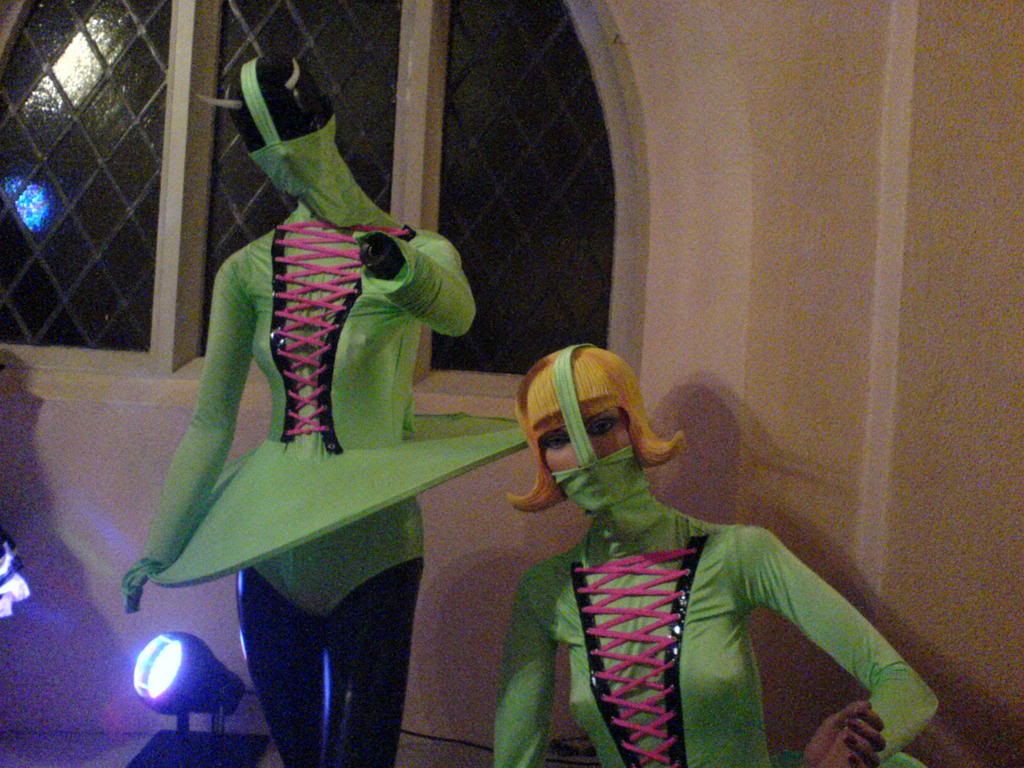 I don't know where the inspiration came from for this piece. It kind of looks like they took elements from ancient Rome including the harsh living environment.
 I found this piece to be rather dull. It's monochromatic for one thing. But I can't understand why they were joined by the hair or by their togas.

The Bata Shoe Museum's exhibit called Footnotes gave me a look into the different walks of life people have. People were encouraged to trace their foot onto a large sheet of acetate that would eventually be hung up or around the museum.

I had the privilege to preserve my footprint and shoe size on one of these large sheets of plastic.

The Canard Development Group (CDG) had an exhibit where it seems like the roof was suspended by balloons. The building itself was incredibly simplistic and I think the exhibit made me think about how simplistic art can sometimes be. If it weren't at night, the "roof" would give shade, and the balloons didn't just float off which amazed me.

Now, from what I was told, String of Diamonds was much more impressive earlier in the night. Some of the lights got damaged, but from what I saw, it was rather enjoyable. To see lights suspended in mid-air, it was kind of mystical. The best part happened when you just stood underneath it or did what some other people did; lie on the grass underneath it.

Another exhibit that I visited was Awakening of the Electronic Forest. It featured live musical performances and poetry. I didn't take pictures of the performances, I figured it would have been a little intrusive. I did manage to get a recording of one of the poems that were being recited through the speakers. From what I got, it was a poem about the music of the forest and how it comes alive through nature and calls out to the author.
"...and from within their ancient note. And now we are so far apart, I am drawn back by your rhythm. Beating, pulsing, singing, sobbing you are calling me, once more beckoning me to the depths of your wood, lay down your body your fears your path, find your ancestor, your mother, your brother, it is here you belong in the arms of the forest..."
The Emergency Room Recruitment Centre was locate in the University of Toronto Art Centre and I was immediately greeted by somebody and invited to write something, anything, on this piece of cloth. The cloth would then be tied to my head, displaying whatever we wrote to people who walked by. Well, naturally, my statement included some person message about myself "I'm cool" and the state I was in at the time "& tired". I decided to used a blue marker for the "cool" part and a red marker for the "tired" part.



The last exhibit I attended was Crowd. It was one of the most surreal and eerie exhibits. It looked like the site of a UFO crash landing. It was surrounded by emergency vehicles and emergency personnel. The watchers had to stay a safe distance away while the people involved spoke to each other and examined the wreckage. The weird thing was that they were speaking, but I couldn't hear anything being said. I think there was a fear that you didn't know what was going, and that uncertainty was pretty overwhelming. I think this exhibit gave off the desired effect.

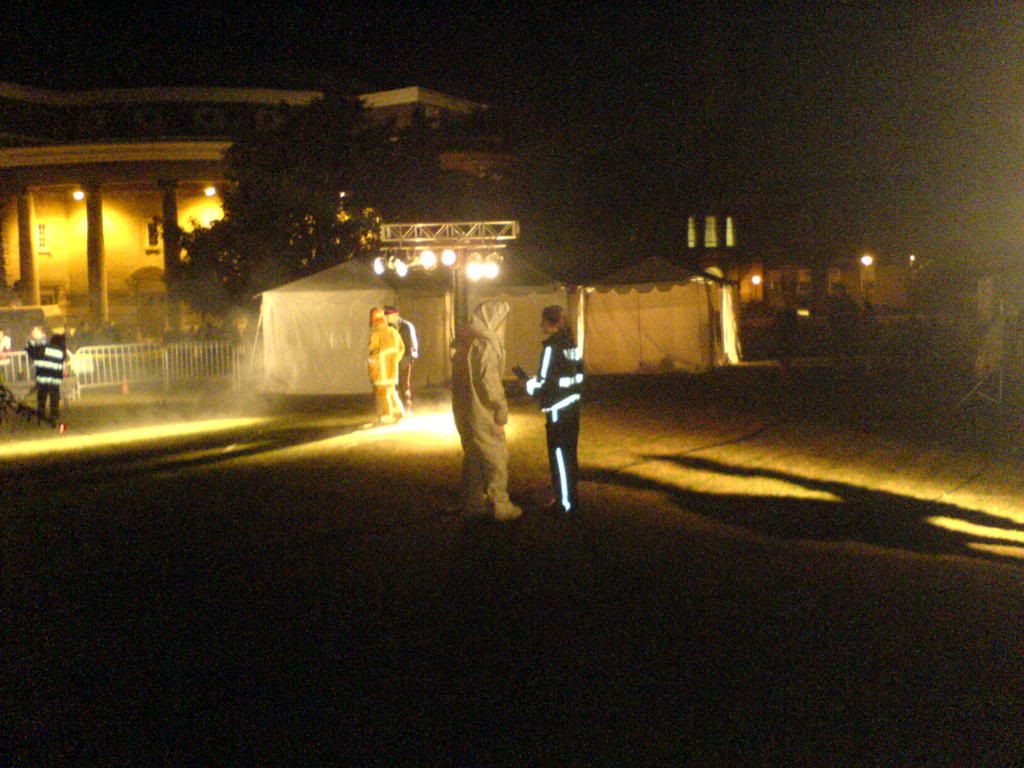


All in all, I thought this was a great experience with many exhibits stimulating my senses. Some were profound, thought-provoking, eerie, and downright bizarre, but I thoroughly enjoy Nuit Blanche.
Stay frosty,
Tim Ling
This piece reminded me of some crazy Teletubby. Perhaps a view on the disillusionment of children's television shows. Teletubbies had tv's in their stomachs too. They're digesting too much media.I have a fear of clowns. This reminded me of a Harlequin in Italian plays. However, I believe the Harlequins were actually more colourful than this one.
I can really appreciate the art in this type of fashion. It's got a futuristic look to it and colours that people don't normally see together. It's like a scene from Mars Attacks.I don't know where the inspiration came from for this piece. It kind of looks like they took elements from ancient Rome including the harsh living environment.I found this piece to be rather dull. It's monochromatic for one thing. But I can't understand why they were joined by the hair or by their togas.The Bata Shoe Museum's exhibit called Footnotes gave me a look into the different walks of life people have. People were encouraged to trace their foot onto a large sheet of acetate that would eventually be hung up or around the museum.
I had the privilege to preserve my footprint and shoe size on one of these large sheets of plastic.
The Canard Development Group (CDG) had an exhibit where it seems like the roof was suspended by balloons. The building itself was incredibly simplistic and I think the exhibit made me think about how simplistic art can sometimes be. If it weren't at night, the "roof" would give shade, and the balloons didn't just float off which amazed me.
Now, from what I was told, String of Diamonds was much more impressive earlier in the night. Some of the lights got damaged, but from what I saw, it was rather enjoyable. To see lights suspended in mid-air, it was kind of mystical. The best part happened when you just stood underneath it or did what some other people did; lie on the grass underneath it.
Another exhibit that I visited was Awakening of the Electronic Forest. It featured live musical performances and poetry. I didn't take pictures of the performances, I figured it would have been a little intrusive. I did manage to get a recording of one of the poems that were being recited through the speakers. From what I got, it was a poem about the music of the forest and how it comes alive through nature and calls out to the author.
"...and from within their ancient note. And now we are so far apart, I am drawn back by your rhythm. Beating, pulsing, singing, sobbing you are calling me, once more beckoning me to the depths of your wood, lay down your body your fears your path, find your ancestor, your mother, your brother, it is here you belong in the arms of the forest..."
The Emergency Room Recruitment Centre was locate in the University of Toronto Art Centre and I was immediately greeted by somebody and invited to write something, anything, on this piece of cloth. The cloth would then be tied to my head, displaying whatever we wrote to people who walked by. Well, naturally, my statement included some person message about myself "I'm cool" and the state I was in at the time "& tired". I decided to used a blue marker for the "cool" part and a red marker for the "tired" part.
The last exhibit I attended was Crowd. It was one of the most surreal and eerie exhibits. It looked like the site of a UFO crash landing. It was surrounded by emergency vehicles and emergency personnel. The watchers had to stay a safe distance away while the people involved spoke to each other and examined the wreckage. The weird thing was that they were speaking, but I couldn't hear anything being said. I think there was a fear that you didn't know what was going, and that uncertainty was pretty overwhelming. I think this exhibit gave off the desired effect.
All in all, I thought this was a great experience with many exhibits stimulating my senses. Some were profound, thought-provoking, eerie, and downright bizarre, but I thoroughly enjoy Nuit Blanche.
Stay frosty,
Tim Ling
Subscribe to:
Comments (Atom)